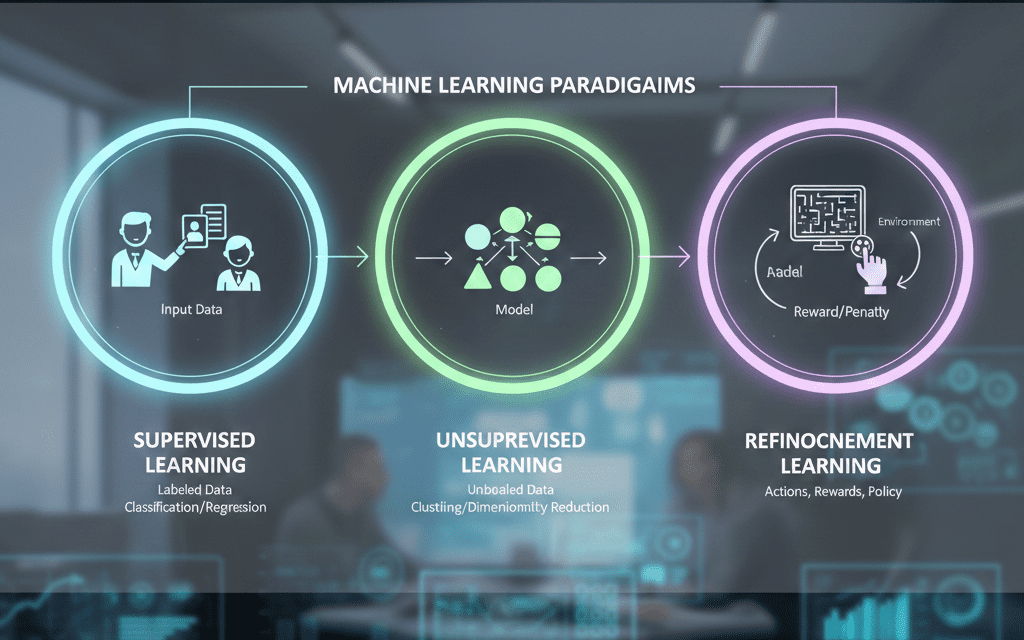
Machine learning is not a single technique but a collection of approaches designed to solve different types of problems. Understanding the three main types of machine learning helps businesses, developers, and decision-makers choose the right solution for their needs.
Supervised Learning
Supervised learning is the most widely used form of machine learning. In this approach, the algorithm is trained on labeled data—data that includes both input values and correct outputs. For example, a model trained to predict house prices might use labeled data that includes house features and their actual sale prices. Over time, the model learns how different features influence price.
Types of machine learning
Common applications include:
- Email spam detection
- Image recognition
- Credit scoring
- Medical diagnosis
Unsupervised Learning
Unsupervised learning works with unlabeled data. The algorithm’s goal is to discover hidden patterns, relationships, or structures without guidance.
A common use case is customer segmentation, where businesses group customers based on behavior without predefined categories.
Common techniques include:
- Clustering
- Association rules
- Dimensionality reduction
Reinforcement Learning
Reinforcement learning focuses on decision-making through experience. An agent interacts with an environment, takes actions, and receives feedback in the form of rewards or penalties.
This approach is commonly used in:
- Robotics
- Autonomous vehicles
- Game-playing AI
- Resource optimization
Choosing the Right Approach
The choice depends on the problem, available data, and desired outcome. Supervised learning works best with structured data, while unsupervised learning excels in exploration. Reinforcement learning is ideal for dynamic environments.Additionally, there is a more specific category called Semi-Supervised Learning and Self-Supervised Learning.
There are several types of machine learning, each with special characteristics and applications. Some of the main types of machine learning algorithms are as follows:
- Supervised Machine Learning
- Unsupervised Machine Learning
- Reinforcement Learning
Conclusion
Each machine learning type serves a unique purpose. Understanding their differences enables smarter implementation and more effective results.